


In-toeing and Out-toeing
Paediatric Management Advice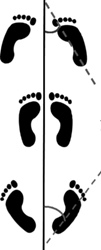
A child is said to have an in-toeing gait when he / she walks with the feet turned inwards - this can also be referred to as ’pigeon toed’. A child is said to have an out-toeing gait when their feet turn outwards. This can be normal as we all have different walking patterns.
Will my child need treatment?
Orthopaedic surgeons tend to recommend a wait-and-see approach for young children. The expectation is that the degree of in-toeing / out-toeing will decrease over time and have corrected itself by the age of 8-10 years. Research has found that walking does often improve over time.
Avoid your child habitually sitting in a ‘W’ position. In this position the knee joints are forced into extreme degrees of outwards rotation. This can contribute to an in- toeing / out-toeing gait. An exercise program to improve the weakness and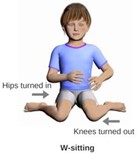
tightness of the hip muscles can improve not only the degree of in-toeing / out-toeing in standing and walking, but also improve the child's ability to perform gross motor tasks that involve walking, running, balance and jumping
Important signs and symptoms to look out for
If your child experiences any of the following symptoms, please seek further urgent medical advice:
• Acute painful limp (or a chronic persistent limp).
• Acute joint pain.
• Joint swelling.
• Night pain: persistent, or not responsive to simple analgesia, e.g. paracetamol, ibuprofen.
• Deep and throbbing ‘bone pain’ – the child often points to the bone rather than joint.
• Systemic symptom, e.g. loss of appetite, fatigue, weight loss, pallor (pale skin).
• Delayed development, loss, or regression of motor milestones.
• Generalised muscle weakness.
Exercises that can help
Try to do these exercises three times a day where possible. You can start the exercises when you notice that your child presents with any of the above issues. Continue them until symptoms resolve.
Balancing on one leg
Practise balancing on one leg for up to 1 minute,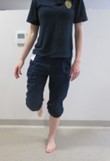 concentrating on keeping your weight on the outside of your foot and your arch lifted off the floor. To make this exercise harder repeat this exercise with
your eyes closed, standing on a pillow / cushion, balancing whilst throwing and catching.
Walking along tracks
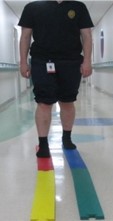
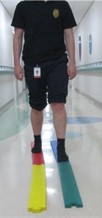
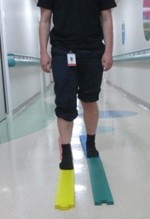 Practise walking along lines in a straight line with feet pointing forwards and hip width apart. Try to build up to 30 steps or 3 times across a room. Complete 3 times a day.
ITB stretch
Lie on your back, with one knee straight, bend the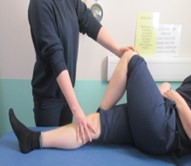 other hip and knee and cross it over the straight leg. Apply downwards pressure on the bent knee. Hold for 30 seconds. Repeat 3 times on each leg. Complete 3 times per day.
Step ups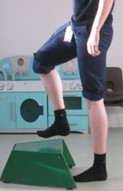
Practise stepping up onto the bottom step of your stairs. Focus on placing your heel down first. Then step up with your other leg. Make sure there is a gap between your knees as you step up and down. Repeat landing with each leg 15 times. Complete three times per day.
Side Step-ups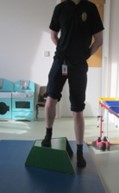
Repeat the previous exercise, this time stepping sideways onto the bottom step. Repeat leading with each leg 15 times. Complete 3 times per day.
Hip Strengthening
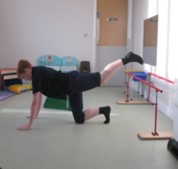 Position yourself on all fours with your hands under your shoulders and knees under your hips. Slowly lift one of your legs off the floor and straighten it out behind you. Hold it for 10 seconds before slowly lowering it back down. Repeat 10 times on each leg. Complete 3 times per day.
If you need any further information or you feel that you need further intervention please contact the Paediatric Physiotherapy department on: 01282 803587 or email paeds.physiotherapy@elht.nhs.uk