


Tip Toe Walking
Paediatric Physiotherapy Management
What is tip toe walking?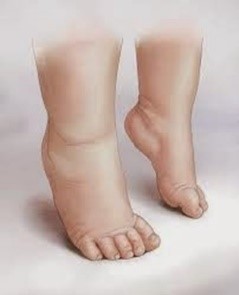
Tip toe walking is when children walk or stand predominantly on their tip toes.
Tip toe walking is relatively common; between 7 and 24 out of 100 children will tip toe walk.
It is more common in boys and often seen in several family members.
When does it occur?
It is common for children aged between 10 and 18 months to walk on tip toes when they are learning to walk as it helps with their balance. Some children continue this up to the age of six or seven, where it usually resolves naturally. However, a small number of children may continue to walk this way as they get older.
What causes tip toe walking?
There are many possible underlying causes, but the following can cause toe walking in some children:
- Short calf muscles (lower leg muscles).
- Weaker trunk muscles in their tummy, back and bottom muscles.
- Habit (habitual tip toe walker or idiopathic tip toe walker) - a child may just get used to tip toe walking for no known reason, thus becomes a habit, as this is ‘normal’ for them. However, over time this can increase muscle tightness / shortening, which then makes it difficult for them to put their feet flat.
- They like the sensation of being on their toes, or dislike ‘the sensation’ of their flat feet touching the floor. This can be associated with autistic spectrum disorders if other signs / symptoms are present.
- In a very small number of cases tip toe walking can be due to underlying causes such as congenital tightness of muscle, neurological or development issues.
How is tip toe walking treated?
- Stretches to lengthen any tight muscles.
- Activities and exercises to strengthen the calf, hamstring, and trunk muscles.
- Gait re-education — encouraging your child to walk slowly and prompting them to walk with their heels down or feet flat.
- Activities to encourage your child to keep their heels down.
- Supportive, well fastened footwear that can help your child maintain a good foot position and improve their walking pattern. Boots that come up over the ankle are often good.
- Serial casting — this is where your child's feet are put into plaster casts for a total of 4 weeks (they are changed at 2 weeks), to slowly stretch out the muscles and increase the movement at the ankle joint. This will be discussed in more detail if it is deemed appropriate.
Are there any alternative treatments?
Going for long walks in stiff boots such as walking boots or wellingtons can be helpful as these types of footwear make it extremely difficult to walk on your tip toes.
In some cases, if the muscles have become too short that there is a muscle contracture, your child may be referred to an Orthopaedic surgeon who may consider surgery to lengthen the tendon at the back of the heel.
Are there any risks with tip toe walking?
Walking on tip toes generally does not cause the child any pain or discomfort and it does not result in any type of deformity. However, it may lead to tightening of muscles in your legs and shortening of the Achilles tendon which can lead to the child being unable to put their heels to the ground. Children can walk, run, and jump on their toes without any problems.
The Role of Physiotherapy
- Determine if there is a specific reason as to why the tiptoe walking is occurring.
- Provide appropriate advice / activities / stretches / exercises that can be completed at home / in the community.
- Onward referral to another service (for example, Orthopaedics) if this is deemed necessary.
- There is usually no need for these children to remain under Physiotherapy long term once all the appropriate advice and exercises have been provided.
When to seek support / advice from a Medical Professional
- If the tip toe walking is only present on one leg
- If the tiptoe walking persists past 3 years of age AND the child is unable to:
o Stand up from the floor without using their hands
o Stand with their heels on touching the floor.
o Jump
- The tip toe walking appears to be in response to pain.
- A recent change in the walking pattern, for example, the child used to walk with their heels down but now has suddenly started walking on their toes.
- There is a deterioration / change in the ability to complete daily activities or physical exercise.
- There is a sudden onset of a new symptom such as muscle weakness, swelling, joint stiffness or joint pain.
An urgent medical assessment should be sought if:
- There is hip, groin and thigh pain in 10–16-year-olds on one side.
- There is leg pain on weight bearing on one side and the hip appears stiff.
- There is a suspected fracture.
- There is a sudden deterioration of function or movement.
- There is constant and unremitting pain.
- There is a sudden onset of an unexplained limp.
Stretching exercises
Try to do these exercises daily. Your child can start these exercises as soon as their toe walking becomes apparent. If your child continues to walk on their toes, it is important to continue with the stretches as your children grow to prevent their muscles from becoming tight. You can space the exercises out throughout the day.
Gastrocnemius Stretch
Stand with your hands against 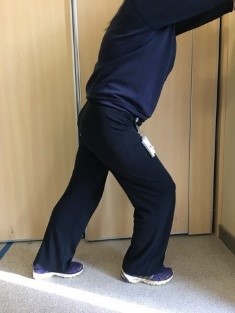 the wall, with one leg behind the other. Keeping your back leg straight with your heel on the floor, slowly bend your front knee and lean forwards until you feel the stretch in your calf muscle on your back leg. Hold the stretch for 30 seconds. Repeat 3 times on each leg, 3 times per day.
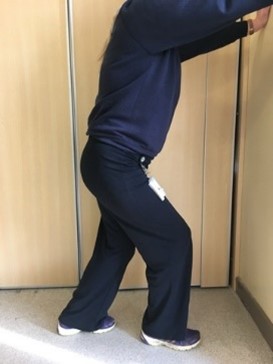
Soleus Stretch
Keep the same position as above, however, this time bend your back knee and sit back as if you were going to sit on a high stool, until you feel the stretch low down in your calf muscle. Hold the stretch for 30 seconds. Repeat 3 times on each leg, 3 times per day.
Heel drops
Stand on the bottom step, with your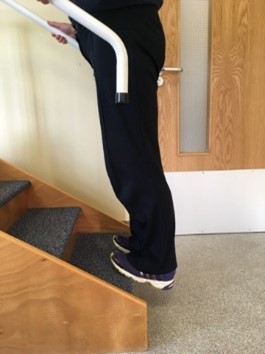 toes on the step, and your heels dangling off the edge of the step. Slowly drop your heels down lower than your toes, until you feel the stretch in your calf muscle. Hold the stretch for 30 seconds.
Repeat 3 times, 3 times per day.
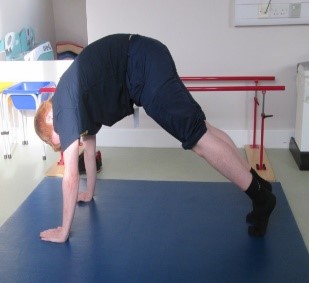 Triangle Stretch
Place your hands shoulder width apart and bend your hips whilst keeping your knees straight to create a stretch at the back of your legs. Hold the stretch for 30 seconds. Repeat 3 times, 3 times per day.
Crossed Leg ITB stretch
Standing with your legs crossed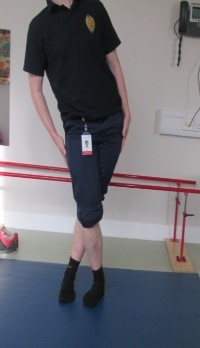 and feet flat on the ground, reach down to the opposite side until you feel a stretch on the outside of your leg. Hold the stretch for 30 seconds. Repeat 3 times on each leg, 3 times per day.
Strengthening exercises
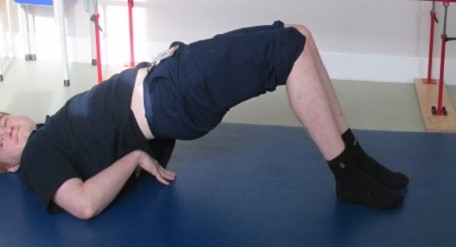 Bridging
Lie on your back with both knees bent and feet flat on the floor. Squeeze your bottom and lift your hips straight up and hold for 5-10 seconds, then slowly lower your hips back down. Repeat 10 times, 3 times per day.
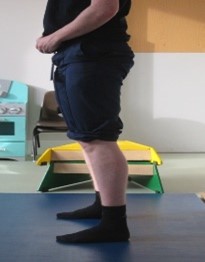 Squats
With your feet hip width apart, slowly bend your knees and hips, bringing your knees straight over you toes whilst keeping both heels flat on the floor. Repeat 15 times, 3 times per day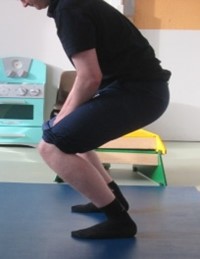
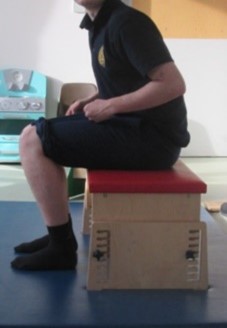
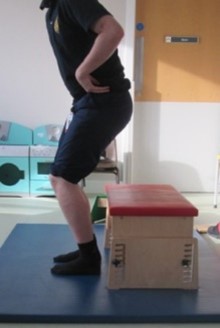
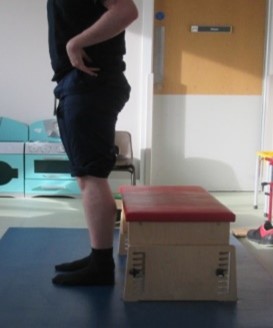
Sit to Stand
Practise standing from a chair or stool while keeping both heels flat on the floor. If needed have someone place their hands below your knees and apply a downwards pressure as a cue to keep your heels on the floor. Repeat 15 times, 3 times per day.
If your child’s tiptoe walking is not improving and you feel you need further information or intervention, please contact the Paediatric Physiotherapy department on 01282 803587 or email paeds.physiotherapy@elht.nhs.uk