

Severs Disease
Paediatric Management Advice
What is Severs?
Severs disease (also known as calcaneal apophysitis) is a type of bone injury in which the growth plate in the back of the heel becomes inflamed and causes pain. It is thought to be the most common cause of heel pain in childhood and adolescence and although it is known as Severs disease, it is not actually a disease.
What causes Severs?
The main cause of Severs is due to the Achilles tendon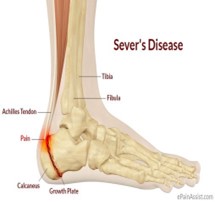
being tight, which causes it to pull on the growth plate.
Muscles or tendons can become tight during a growth
spurt, as bones grow faster than muscles.
Who does it affect?
- Boys between 8 to 10 years old
- Girls between 10 and 12 years old
- Children in a ‘growth spurt’
- Children who are very active and play a lot of sports, usually those that involve running and jumping
What are the symptoms of Severs?
- The most common symptom is pain at the back of the heel on one or both sides, and in some cases swelling.
- The pain can get worse with physical activity such as running or jumping and sometimes causes limping or walking on the toes.
- It usually feels better with rest.
Important signs and symptoms to look out for
If your child experiences any of the following symptoms, please seek further urgent medical advice:
- Swelling or bruising, not improved by elevation or rest
- Regular or constant night pain
- Leg deformity if this follows a traumatic injury
- Loss of sensation or persistent pins and needles / numbness in leg
- There is a sudden deterioration of function or movement.
- There is a sudden onset of an unexplained limp.
- Pain that does not settle with rest or reduction of activity
- Increased temperature, feeling hot and shivery may indicate an infection
- Redness and heat at hip, knee or ankle may indicate an infection
- Inability to walk on the leg
Only continue to read if you have none of the above symptoms
Getting better
It may take several weeks or months for the pain to completely stop. In most cases, Severs disease goes away on its own with a little rest and time. However, if you ignore the pain and play through it, the condition may get worse and may be more difficult to treat.
Once the acute pain has improved, you can gradually return to your previous level of activity. However, if the pain worsens with this increase, reduce or modify the level of activity slightly to allow further recovery. With future growth spurts, the pain may return therefore keep up with the stretches and follow the advice given.
Treatment
There is nothing you can do to stop Severs disease (it will stop when you finish growing around 16 -18 years). However the following will help to relieve the symptoms;
- Rest - cut down on the time playing sports until the pain has resolved. Avoid sports that involve a lot of running or jumping or even try swimming instead.
- Ice - apply ice wrapped in a damp cloth for 15-20 minutes, especially after activity. Do not apply ice if your child has circulatory problems or reduced skin sensation.
- Elevation - if the leg swells, elevate (raise) it on something higher than the hip.
- Pain relief - consult your GP or local pharmacist for advice on which medication is suitable for your child to take.
- Appropriate footwear - avoid activities in bare feet. Choose a supportive shoe with the laces done up with a well cushioned heel. Unfortunately, Converse, Vans, Uggs and ‘dolly shoes’ are not advised. A running trainer is much more suitable.
- Physiotherapy exercises - some of these stretches are included below.
Orthotics
Gel heel cups worn in your shoes, especially when doing sports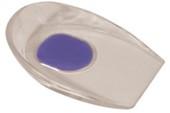
will help to relieve some of the symptoms and relieve the pain by providing cushioning to the underneath of your heel.
Stretches
Stretches to your Gastrocnemius and Soleus will help to lengthen the muscles in your calf, to relieve the pressure of the Achilles tendon pulling on your heel bone, and relieve the pain. Hold each stretch for 30 seconds and repeat 3 times. Complete stretches 3 times a day.
Gastrocnemius (calf muscle) Stretch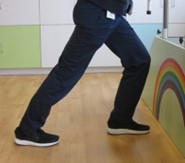
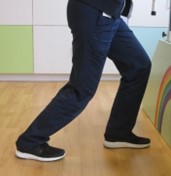
Leaning against a wall, place one foot in front of the other. Keeping your back leg straight and keeping your heel on the floor, bend your front knee until you feel a stretch in your calf muscle on the back leg.
Soleus (calf muscle) Stretch
Leaning against a wall, place one foot in front of the other. Keeping in the same position as above, and keeping your heels on the floor, bend both knees until you feel the stretch lower down in your calf on the back leg.
Heel Dips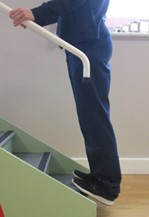
Stand on the bottom step. Holding onto the handrails, stand with your toes on the step and your heels hanging off the edge of the step, then slowly drop your heels down below the edge of the step until you feel a stretch in your calf muscles.
 Plantar Fascia Stretch
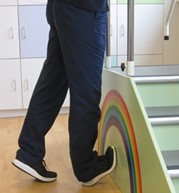
Stand with your toes against a wall pointing upwards. Lean forwards against the wall until you feel a stretch in both your calf muscle and underneath the sole of your foot.
If you need any further information or you feel that you need further intervention please contact the Paediatric Physiotherapy department on: 01282 803587 or email paeds.physiotherapy@elht.nhs.uk