


Good Posture in Children
Paediatric Management Advice
What is good posture and why is it important?
Posture is the position of your body when you sit or stand. When you look at the spine from behind it should look like it runs in a straight line but when viewed from the side, it should have natural curves. Good posture allows us to sit or stand with minimal effort and without causing strain on our bodies. It also helps us avoid developing pain and stiffness. Braces and splints are not usually required to achieve a good posture. We encourage children to do this actively through exercise to build up their muscles.
What causes poor posture?
There are two types of poor posture: correctable and fixed. Correctable posture is usually caused by sitting or standing in a slouched position over a long period of time, whereas fixed cannot be altered and restricts movement.
What does poor posture look like? 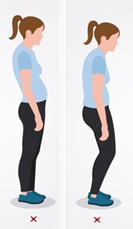
- Poking chin
- Rounded shoulders
- Hyperextended knees
- Pelvis tilted forwards
- Bottom sticking out
Sitting at a desk
Leaning over a desk for long periods of time is not good for your posture and can lead to neck and back pain. Ideally sit at a desk where your feet are on the floor, your chair has a back rest, and your bottom is as far back in the seat as you can get it. Secondary school children can spend up to 5 hours a day sitting at desks. Fewer children are walking to school due to safety and time pressures. More time is spent sitting watching TV and playing computer games. This all can have an impact on posture.
Poor sleeping posture 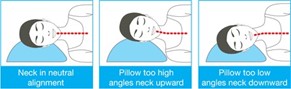
Sleeping without enough or with too many pillows causes your neck to tilt. To ensure a better sleeping position, make sure you use a pillow which fills the space between your head and shoulder, keeping your spine in a neutral position.
Carrying school bags
Carrying heavy bags on one shoulder causes you to lean over to one side, making the body asymmetrical. The best way to carry a school bag is to:
- Use both shoulder straps of a rucksack to distribute the load evenly.
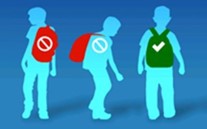
- Don’t load the bag too heavy — it should be less than 10% of your body weight.
- Keep the straps tight so that the top of the bag is in line with the top of your shoulders.
Technology
Technology plays a huge role in our children’s lives at school and at home. Often there is little thought about what postures children adopt when using mobile devices, e.g. hunched over, staring at screens. Spending prolonged time in these positions can have a huge impact on a child’s posture. Try to reduce screen time and encourage regular changes of position. Spending time outdoors participating in more active hobbies will help a child to build up their strength which will have a positive impact on their posture.
Adopting poor postures
Sitting and standing with poor posture weakens our muscles over time and causes stiffness. Weakness is caused by not using your core muscles in an effective way, this can be more difficult during a growth spurt. Stiffness is caused by the tightening of some muscles and the stretching of others when adopting a poor posture.
How to maintain a good posture
In sitting, gently lengthen the back of your neck by reaching the top of your head up towards the ceiling, so that you are looking straight ahead. Gently move your shoulder blades down your back and allow the muscles in your neck and shoulders to relax. Your feet should rest flat on the floor with your weight equally distributed through both buttocks. In standing, make sure equal weight is distributed between both feet. Ensure your feet are hip distance apart, and your hips and shoulders are in line with your knees. Keep your knees soft and lengthen your spine by reaching the top of your head up to the ceiling.
Exercises to help maintain a good posture
Completing the following exercises on a daily basis will help with core strengthening and allow you to maintain a good posture for longer periods of time. Complete exercises 3 times a day.
Chin Tucks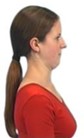
Sitting straight-backed, pull in your chin, keeping your neck and back straight (not tipping your head forwards). Hold for 5-10 seconds. Repeat 10 times.
 Shoulder positioning exercise
Stand or sit. Move your shoulder blades gently back and down (small movement) Hold for 5-10 seconds. Repeat 10 times.
Shoulder press up against a wall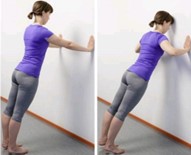
Standing against a wall with your hands just wider than your shoulders, slowly bend your elbows so that your chest moves towards the wall. Then return to the start position. Repeat 10 times.
Clam
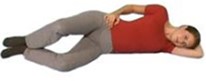 Lie on your side with your knees bent. Tighten your buttocks to lift your top knee as far as you can without letting your pelvis rotate forward or backwards. Keep your feet together and back straight during the exercise. Hold for up to 30-60 seconds. Repeat 3 times on each side.
Bridge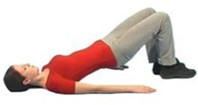
Lie on your back with your knees bent and feet on the floor. Lift your pelvis and lower back gradually off the floor. Hold for 5 seconds. Slowly return to the starting position.
Repeat 10 times.
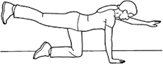
Superman
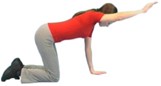 Start in a crawling position with your hands under your
shoulders and knees under your hips. Keep your back straight and core muscles tight. Slowly lift one arm in front of you and hold for 10 seconds. Repeat 5 times with each arm. If this becomes easy, try with your leg or even youropposite arm and leg.
If you need any further information or you feel that you need further intervention please contact the Paediatric Physiotherapy department on 01282 803587 or email paeds.physiotherapy@elht.nhs.uk