


Balance and Co-ordination
Paediatric Management Advice
What is balance and co-ordination?
Balance is the ability to maintain a controlled body position during a task. To function effectively across environments and tasks, we need the ability to maintain controlled positions during both static (staying still) and dynamic (moving) activities.
Why is balance and co-ordination important?
Age-appropriate balance and co-ordination allows children to be involved in sports alongside friends and feel included. With good balance and co-ordination there is less likelihood of injury. Balance and co-ordination also help maintain good posture.
How can I tell if my child has problems with balance and co-ordination?
If a child has difficulties with balance and co-ordination they might:
- Fall easily, trip often or struggle to ‘recover’ quickly from being off balance.
- Move stiffly and lack fluid body movement.
- Avoid / fear physical activity or new games.
- Be late to reach developmental milestones (e.g. crawling and walking).
- Be slower or less skilful than their peers with physical skills.
- Become tired quickly with activity or have trouble navigating uneven environments.
Important signs and symptoms to look out for:
If your child experiences any of the following symptoms, please seek further urgent medical advice:
- Constant pain
- Regular or constant night pain
- Abnormal weakness
- Unable to weight bear through their leg
- Limping when walking
- Delayed or regression of developmental milestones.
What can be done to help improve balance and co-ordination skills?
It is possible to improve balance and co-ordination by challenging these skills through activity and by engaging in exercise. It is important that children maximise movement opportunities, so that they can develop their motor skills and to encourage activity for life. It may not be possible to improve all balance and co-ordination problems completely, however being strong and active is the best way to make a positive influence.
What activities can help improve balance and coordination?
- Walking over unstable surfaces at outdoor parks, indoor adventure play centres or even at home with the use of pillows on the floor.
- Using a bike or scooter outside.
- Swimming - this involves the body having to work against the resistance of water, therefore providing better awareness of where the body is in space.
- Games such as ‘Simon Says’ which encourage different movements and positions to be held.
How much exercise should my child be doing?
- Age 1-5: At least 180 minutes (3 hours) per day in a variety of physical activities at any intensity, including active and outdoor play, spread throughout the day.
- Age 5-16: 60 minutes per day across the week of moderate to vigorous intensity physical activity. This can include P.E., walking, after-school activities, and sports and should be varied to develop movement skills, muscular fitness, and bone strength.
Children with balance and co-ordination difficulties may face more challenges when it comes to engaging in physical activity. They can easily be put off from participating if they have continuous difficulty. It is therefore important that activities should be achievable and enjoyable so that they are a ‘manageable challenge'.
Benefits of Exercise for Children
- Maintains a strong heart and ensures healthy growth and development
- Improves posture, balance, and general co-ordination
- Builds and maintains strong healthy muscles, bones and joints and reduces obesity
- Reduces anxiety, depression and improves self-esteem
Below are some examples of exercises to help build strength and help improve your child’s balance and co-ordination skills. Children should always be supervised when exercising.
If you need any further information or you feel that you need further intervention please contact the Paediatric Physiotherapy department on 01282 803587 or email paeds.physiotherapy@elht.nhs.uk
Strengthening Exercises
Bridge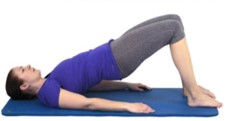
Lying on your back, bend your knees and have both feet flat on the floor. Squeeze your tummy and bum muscles and slowly lift your hips in the air. Try to make a straight line between your shoulders and knees. Hold this position for 5-10 seconds. Repeat 10 times.
Superman
Start in a craw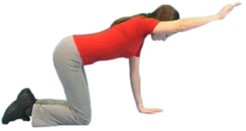 ling position with your hands under your shoulders and knees under your hips. Keep your back straight and tummy muscles tight. In this position, see how many high 5s you can give whilst keeping your back straight. Swap over to the other arm. Once this becomes easy, try it with your opposite arm and leg. Repeat for 1 minute.
Sit to Stand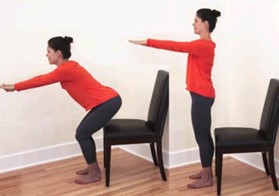
Start by standing up tall, slowly sit down on a secure chair behind you as the picture shows. Don't sit down for longer than 3 seconds, beofre standing up slowly. Repeat 15 times.
Clam
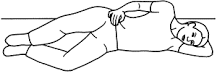 Lying on your side with your knees bent, keep your feet together and lift the top leg slowly, like a crocodile’s mouth opening. Hold for 30-60 seconds before slowly lower your leg down. Repeat 3 times on each leg.
Level One — Balance and Co-ordination Exercises
Start by completing the exercises on level one and then once you find these exercises easy, progress onto the level two.
1. Practice balancing on one leg. Hold your arms out if you need to.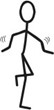 Practice holding this position for as long as you can. Repeat with both legs.
2. Pr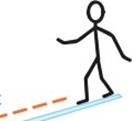 actice walking in a straight line, heel to toe, along a 5 metre line.
3. Practice jumping along the floor with your feet together and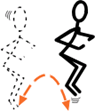 knees bent. Repeat 10 times.
4. Pr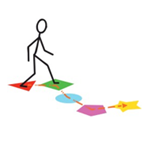 actice stepping along a route placing your feet onto coloured shapes or into hoops. Vary the distances and directions of the stepping targets.
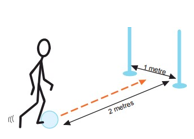
5. Practice kicking a ball in between two posts as if you were scoring a goal. Try with both feet. Repeat 10 times.
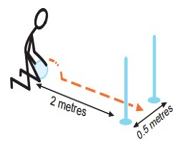
6. In a high kneeling position, practice rolling a ball with one hand in between two posts. Try with the other hand. Repeat 10 times.
Level Two — Balance and Co-ordination Exercises
Once you find the exercises on level two are getting easier, attempt the exercises on level three.
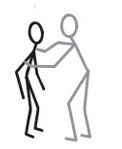
1. Stand or kneel as the picture shows. Practice keeping still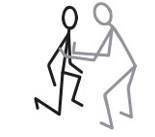 whilst your partner gently pushes you. Swap over and kneel on the opposite leg.
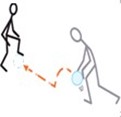
2. Get your partner to roll a ball towards you and practice stopping the ball by placing your foot on top. Try this with each foot in turn.
3. In a high kneeling, position (kneeling so that your thighs are off your calves and 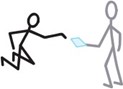 your back is straight), try to hold for at least a count of 30-60 seconds. To make it harder, you can throw and catch a ball or reach for an object in different positions without sitting down.
4. Stand c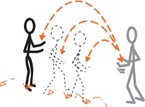 lose to a partner. Throw and catch a ball between you. Each time you are successful, take a step backwards. Keep increasing the distance until you can't catch the ball.
5. Practice walking in a straight line, heel to toe, with a bean bag or light book on your head, 
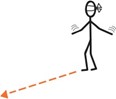 without looking down. You can also try this with your eyes closed.
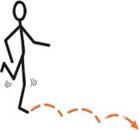
6. Practice hopping 4 paces in a straight line. Do this on the left leg and then on the right leg. Repeat 5 times.
Level Three - Balance and Co-ordination Exercises
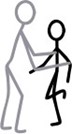 1. Practice standing still like a statue and balance on one leg. Get a partner to gently push you whilst trying to maintain your balance. Try with your other leg.
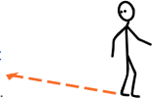
2. Practice walking toe to heel backwards in a straight line. You can look to see where you are going. You could also try doing this whilst balancing something light on your head.

3. Practice standing on one leg with your arms folded. Repeat on the opposite leg. You can make this harder by closing your eyes or by standing on a cushion.
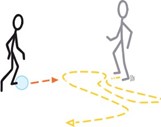
4. Practice kicking a ball between you and a partner whilst one of you moves around slowly.
5. Balancing on one leg, practice pointing to the markings on the floor using your other leg whilst keeping a steady balance. Repeat with both legs.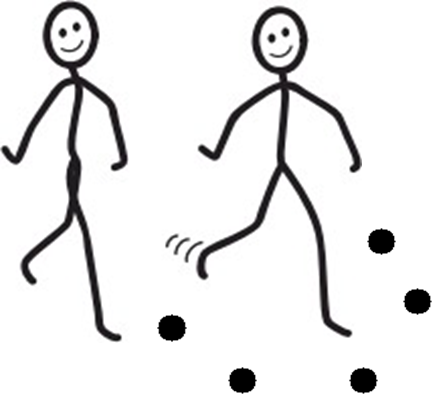
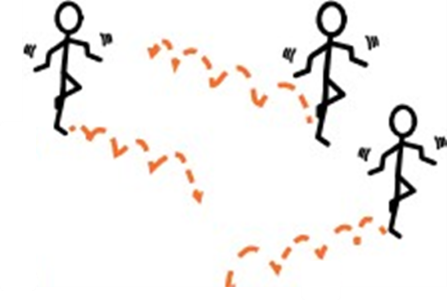 6. Practice hopping on one leg. Do 4 hops and then stop. Repeat on both legs. Can you hop to the left, right, forwards and backwards?